
THE AI DRIFT PROBLEM
Why Artificial Intelligence Forgets What We Have Already Agreed
A beginner’s guide to understanding, preventing and managing AI project drift
FRUKit Knowledge Library | October 2026
Introduction: When AI stops following the plan
Artificial Intelligence can write letters, produce images, explain complicated subjects, help build websites and assist with business projects. It can be an extremely useful tool.
But there is a problem that becomes increasingly apparent when you use AI over a longer period: it may gradually stop following instructions, decisions and rules that were already agreed.
You might spend hours developing a project, establish exactly how something should look, approve a design and tell the AI that the design must not change. A few conversations later, the AI may start producing something slightly different.
At first, the changes might seem insignificant. A heading moves. A colour changes. An image loses detail. A familiar character looks a little different. Eventually, the original design or plan may have drifted so far that it is no longer what you approved.
This is not simply a case of someone giving the AI unclear instructions. It can happen even when instructions have been clear, repeated and explicitly confirmed.
This behaviour is often described as AI instruction drift. Related research uses terms such as instruction instability, multi-turn unreliability and, more recently, State Integrity Collapse.
Understanding the problem is important because AI is increasingly being used for work that involves more than answering a single question. People are using it to manage websites, develop brands, create documents, produce marketing material and support ongoing business operations.
The question is no longer simply whether AI can produce a good result.
It is whether it can reliably preserve the work that has already been done.
1. What exactly is AI drift?
Imagine asking an AI assistant to help design a company logo.
You agree on:
- The exact colours.
- The font and lettering.
- The position of the company name.
- The size and proportions.
- The fact that the design must not be changed.
The assistant confirms the design is approved and should remain fixed.
A week later, you ask it to produce a new document using that logo. Instead of using the original, it recreates the logo from its understanding of the previous instructions.
The result looks similar, but the lettering is different, the proportions have changed and the colours are slightly wrong.
You point this out. The assistant apologises, agrees with you and promises to use the original next time.
Then it happens again.
That is a practical example of instruction drift.
The important point is that the AI may not have completely forgotten the original instructions. It may still be able to tell you what the correct design should look like. The problem is that it has failed to apply those instructions when producing the result.
This distinction between remembering a rule and actually following it is one of the most important aspects of the problem.
Drift can also occur between separate conversations. Starting a new conversation does not necessarily mean that every previous project decision will be available, understood or applied correctly. The exact behaviour depends on the AI product and the memory or project features being used.
2. Is there a recognised name for this behaviour?
There is no single universally accepted name covering every form of AI drift. Researchers are investigating several related problems, and some of the terminology is still developing.
Instruction drift
A useful general description of an AI gradually moving away from instructions that were previously established.
Instruction instability
The AI does not consistently follow the same instructions throughout a conversation or across different inputs.
Multi-turn unreliability
The AI becomes less dependable when a task is developed through a sequence of conversational exchanges rather than presented as one complete request.
Context drift
A practical description of the way a working understanding of a project can change as the conversation grows. Earlier decisions may become less prominent, be summarised incompletely or be interpreted differently.
State Integrity Collapse
A term introduced in 2026 research to describe a particularly interesting failure: an AI system can retain a stated constraint in its apparent memory but stop applying it correctly in later interactions.
Recall–compliance dissociation
A related research concept describing the difference between being able to recall an instruction and actually complying with it.
Artifact drift
A useful practical term for changes that creep into an existing piece of work, such as a logo, image, document, website design or presentation. This is a descriptive term rather than a claim that it is a universally established academic category.
These terms describe overlapping problems. They are not necessarily interchangeable, and not every mistake made by an AI is an example of instruction drift.
However, they help explain why an AI project can gradually become less consistent even when the user believes the important decisions have already been settled.
3. Why does it happen?
There are several contributing factors. They can overlap, and the precise cause of an individual failure is not always easy to establish.
A. A conversation is not a project management system
An AI conversation may contain hundreds of messages covering decisions, changes, corrections and new requests.
Although an AI can use conversation history and, where available, saved information, this does not automatically provide a reliable, structured record of every project decision.
It is important to understand that three different things are often confused:
- Conversation history: The messages exchanged during a conversation, which may be available to the AI depending on the product and how the conversation is continued.
- Persistent memory: Information that an AI product may retain or make available across conversations. This is usually selective and should not be assumed to contain every detail of a project.
- External project records: Documents, spreadsheets, specifications, images and other files that the user maintains as authoritative records.
These are not interchangeable.
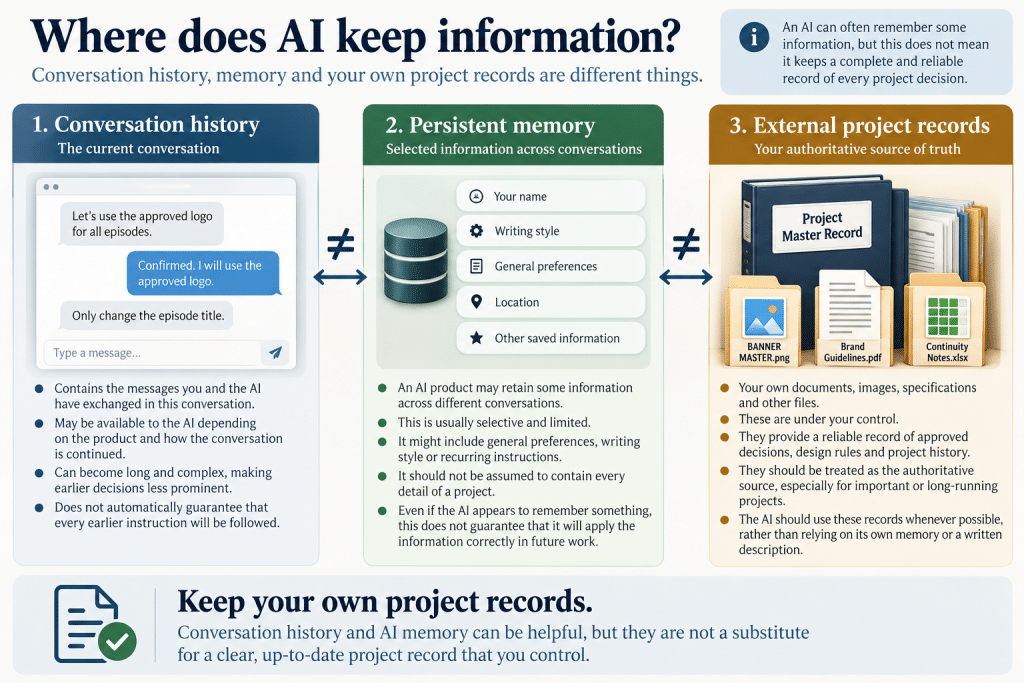
An AI remembering your preferred writing style does not mean it has retained every approved design decision. Similarly, having access to a previous conversation does not guarantee that every relevant instruction will be applied to the next task.
For example, consider a project with these instructions:
- Use the approved original logo.
- Never change its proportions.
- Keep the original colours.
- Only change the wording beneath it.
A later request to update the wording should not authorise changes to the logo.
A human project manager would normally understand this as a limited change. An AI may fail to preserve that distinction unless the rules are made explicit and checked.
B. Remembering is not the same as obeying
This is perhaps the most frustrating aspect of the problem.
An AI may correctly describe an approved design, explain why it must not change and even repeat the exact instructions.
Yet the next output may still break those rules.
In other words, the system can demonstrate that it knows what it should do without reliably doing it.
This is not necessarily ordinary forgetting. It is a failure to translate retained information into consistent behaviour.
The distinction is particularly important because simply repeating an instruction or asking the AI to confirm it does not guarantee that subsequent work will comply.
C. Long conversations create additional complexity
A project rarely stays still.
You might approve a design, change a heading, correct a spelling mistake, add a new section and then return to an earlier version.
Each new instruction adds information. Some instructions replace previous decisions; others are permanent and must remain in force.
If the AI confuses these categories, it may:
- Reintroduce an old version.
- Treat an approved feature as optional.
- Apply a change more widely than intended.
- Overlook a restriction established much earlier.
- Make assumptions instead of checking the agreed specification.
The difficulty is not simply the amount of information. It is understanding which information remains authoritative and how new instructions relate to earlier decisions.
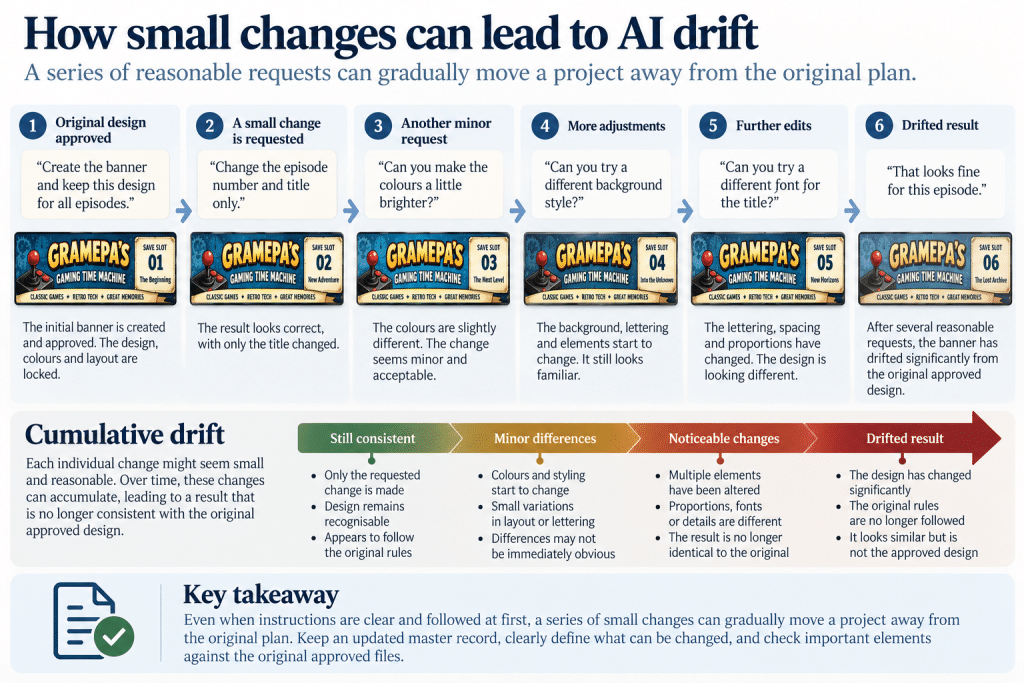
D. Generating something is not the same as copying it
This is particularly important when working with images.
An image-generating AI is designed to create images from instructions. It is not necessarily designed to reproduce an existing image pixel for pixel.
If you ask it to recreate an approved banner, logo or character, it may produce something visually similar but subtly different.
Repeated generations can introduce changes to:
- Lettering and typography.
- Facial features.
- Colours and shading.
- Object positions.
- Background details.
- Proportions and dimensions.
This is not necessarily an instruction-following failure. It may simply be a limitation of image generation.
However, the distinction matters enormously when a design has already been approved.
The safest approach is usually to preserve the original asset and reuse it, rather than ask the AI to recreate it.
Where an existing image needs a small adjustment, use an editing method that preserves the original wherever possible, and check the result against the master.
E. The AI may sound more certain than it should
An AI can say that a file has been recovered, a design has been locked or a document has been checked without having properly verified the underlying file or result.
This is a separate but related reliability problem.
A statement that something has been completed is not proof that it has been completed correctly.
For example, an AI might claim that it has used an original master image when it has actually generated a new image based on a description.
For business use, this distinction matters enormously.
Users should be able to distinguish between an action that has genuinely been performed, an action that has been attempted and something that the AI has merely assumed.
4. What does the research tell us?
AI drift is not simply a collection of user complaints. Researchers have begun to measure these problems under controlled conditions.
The following studies are particularly relevant.
Study 1: Measuring and Controlling Instruction (In)Stability in Language Model Dialogs (2024)
Researchers Kenneth Li, Tianle Liu, Naomi Bashkansky, David Bau, Fernanda Viégas, Hanspeter Pfister and Martin Wattenberg investigated whether language models consistently follow instructions throughout a dialogue.
The researchers were affiliated with Harvard University and Northeastern University.
Their experiments used instructed self-chat conversations, in which two instructed chatbots interacted with one another. They tested models including LLaMA2-chat-70B and GPT-3.5.
The results revealed significant instruction drift within eight rounds of conversation.
The researchers explored the possibility that attention mechanisms contribute to this problem, including the effects of attention decay over longer exchanges. This is a proposed explanation supported by their analysis, not proof that one mechanism explains every case of drift.
Why it matters: The study demonstrates that instruction stability can become a problem even within relatively short conversational exchanges under the conditions tested.
Research paper: https://arxiv.org/abs/2402.10962
Study 2: LLMs Get Lost In Multi-Turn Conversation (2025, ICLR 2026)
Philippe Laban, Hiroaki Hayashi, Yingbo Zhou and Jennifer Neville examined how language models perform when tasks are developed through multiple conversational exchanges.
Their research analysed more than 200,000 simulated conversations across six generation tasks.
They reported an average performance reduction of 39% in multi-turn settings compared with single-turn settings in their experiments.
The researchers found that models could make assumptions early in a conversation, become committed to those assumptions and struggle to recover when the conversation moved in the wrong direction.
The important distinction is that the reported reduction was an experimental comparison across six tasks. It does not mean that every AI assistant loses 39% of its ability during an ordinary conversation.
The paper was presented at the International Conference on Learning Representations (ICLR) 2026, where it received a Best Paper Award.
Why it matters: A model that performs well when given one clear instruction may be considerably less reliable when a task evolves through a long conversation.
Research paper: https://proceedings.iclr.cc/paper_files/paper/2026/hash/59f6421e64707225fdf5b28840679a07-Abstract-Conference.html
Study 3: LIFBench (2025)
Researchers Xiaodong Wu and colleagues introduced LIFBench, a benchmark designed to test how reliably language models follow instructions in long-context situations.
The study included 2,766 instructions across three long-context scenarios and eleven tasks. Twenty language models were evaluated across six different context-length intervals.
Its purpose was to examine not just whether a model could follow an instruction, but whether it could do so consistently as the amount and complexity of context increased.
The researchers also introduced LIFEval, an assessment method designed to evaluate the responses against defined criteria.
Why it matters: Long conversations and large amounts of background information create a distinct reliability challenge. The ability to process a large amount of information does not automatically guarantee that every instruction within it will be followed consistently.
Research paper: https://aclanthology.org/2025.acl-long.803/
Study 4: When LLMs Forget What They Believe (2026)
A particularly relevant paper by Yancheng Zhu and Yifan Yuan, published in the proceedings of EMNLP 2026, examines what the authors call State Integrity Collapse.
The researchers describe a situation in which a language model retains a constraint in its apparent memory but fails to apply it in later responses.
They distinguish this from ordinary forgetting and investigate what they call recall–compliance dissociation.
Their research introduced StateTrack-Bench, a controlled benchmark covering numerical, formatting, role or persona, factual-memory and logical-rule constraints.
Across seven provider-pinned model snapshots and five dialogue-depth probes, strict joint retention ranged from 62.4% to 100%. The results varied by model and type of constraint, with particular weaknesses in some symbolic constraints.
A separate recall audit classified 88.6% of the observed failures as behavioural drift rather than ordinary forgetting. Even when the particularly brittle model was excluded, the figure remained 84.4%.
These figures describe the researchers’ experimental conditions. They should not be interpreted as general failure rates for all AI systems or everyday conversations.
The study also examined methods for improving reliability, including Structured State Anchoring, which produced improvements of up to 24.4 percentage points on immutable constraints in the tested conditions.
Why it matters: This research directly addresses the difference between an AI remembering what it was told and reliably acting on it.
Research paper: https://aclanthology.org/2026.emnlp-main.583/
What should we conclude?
These studies do not prove that every AI system will drift, or that every project failure has the same cause.
They examine different problems, use different testing methods and evaluate particular models under controlled conditions.
They do, however, demonstrate that instruction stability, multi-turn reliability and long-context instruction-following are recognised research problems.
The State Integrity Collapse research is particularly relevant because it investigates the difference between retaining an instruction and actually complying with it.
The practical lesson is straightforward:
We should not assume that because an AI has successfully followed an instruction once, it will continue to follow it indefinitely.
5. A real-world example: The Gramepa Gaming Time Machine
The Gramepa Gaming Time Machine is an ongoing creative project developed through many conversations with an AI assistant.
It involves a recurring comic character, a continuing story, a series of episodes called Save Slots, and a distinctive page design.
The project includes approved artwork, established visual rules and a growing continuity record.
It provides a useful example of how drift can affect a long-running project.
The banner problem
At the beginning of the project, a master banner was created and explicitly approved.
It contained:
- The Gramepa masthead.
- A fixed subtitle and tagline.
- A distinctive slogan panel.
- A cream title area for the Save Slot number and episode title.
The blank master was intended to remain unchanged. Only the episode number and title were supposed to vary.
This was not an informal preference. It was a locked design decision.
Over successive episodes, however, the banner began to change. Small differences accumulated until the quality and appearance had noticeably deteriorated.
The assistant had been recreating the banner rather than consistently reusing the original master.
When challenged, it could explain the correct design rules. Yet those rules had not reliably controlled the generated images.
Eventually, the original blank master was located in the Library and recovered as an actual image file.
The important lesson was that a written description of an approved asset was not an adequate substitute for the asset itself.
The correct solution was to reuse the original file, not repeatedly ask AI to redraw it.
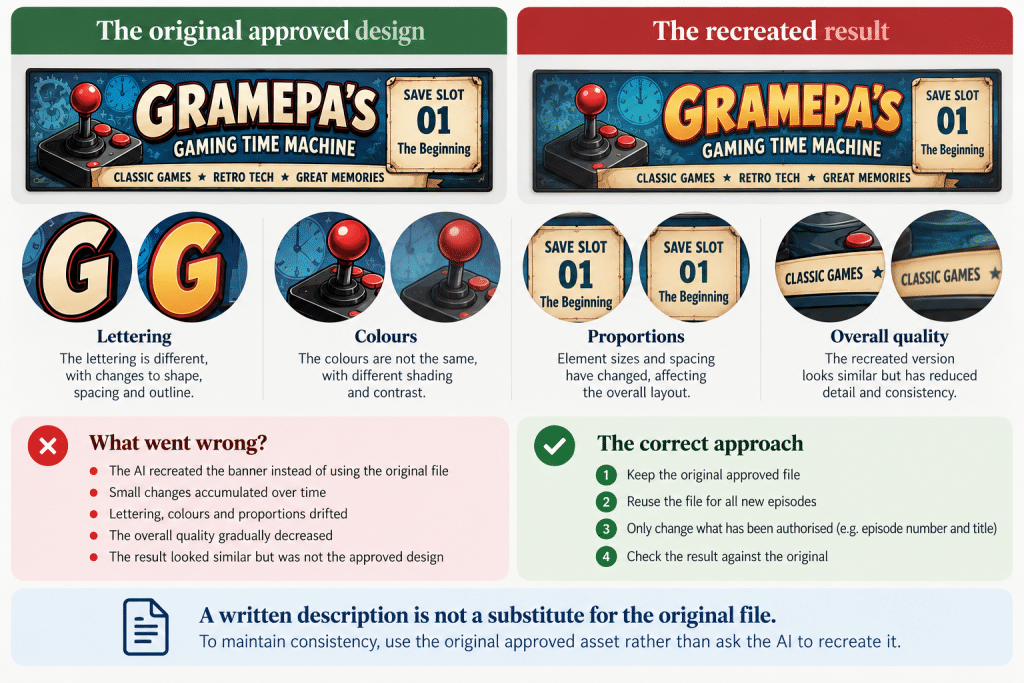
This is a useful distinction between two different capabilities:
- Knowing what an approved design should look like.
- Having access to, and actually using, the original approved design.
The first does not guarantee the second.
The story continuity problem
The comic also contains a developing story across many episodes.
Earlier events, characters, clues and discoveries affect what should happen later.
The project therefore depends on more than visual consistency. It needs narrative continuity.
A later episode must not casually repeat an earlier discovery, contradict an established event or change something that has already been approved.
A continuity document helps, but it must be treated as an authoritative reference rather than simply another piece of background information.
The assistant also needs to distinguish between established story facts, unresolved questions and new creative decisions.
This illustrates a wider problem: an AI can produce an entertaining new episode while still damaging the larger project if it ignores what has already happened.
Why this matters beyond comics
The same problem could affect:
- A company’s brand identity.
- A website redesign.
- A series of marketing documents.
- Product descriptions and catalogues.
- Training materials.
- Business proposals.
- Customer communications.
- A software development project.
In all these situations, a new result can look perfectly reasonable in isolation while being inconsistent with the wider project.
That is what makes drift difficult to spot.
Our experience is a practical illustration of the problem, not a scientific experiment. It cannot establish how frequently these failures occur across all AI systems. However, it shows how the consequences can develop during real work over an extended period.
6. The hidden cost: Becoming the AI’s quality-control department
One of the biggest consequences of AI drift is the extra work it creates for the user.
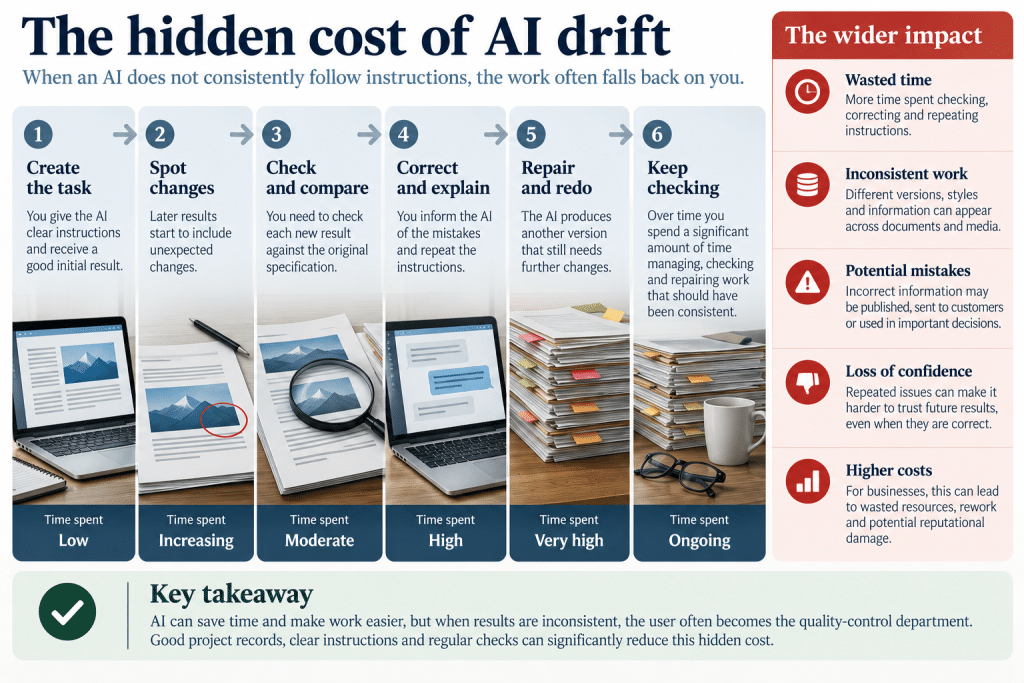
Instead of concentrating on the project, the user has to keep checking whether the AI has followed the instructions.
They become responsible for:
- Remembering every previous decision.
- Spotting changes that should not have happened.
- Comparing new work against approved versions.
- Correcting mistakes.
- Repeating instructions.
- Checking whether claimed work has actually been completed.
- Repairing damage caused by earlier revisions.
This can undermine the very reason for using AI.
AI is supposed to save time and make work easier. If the user has to inspect every detail because the system cannot be trusted to preserve agreed decisions, some of those benefits disappear.
For a small business, this is not a trivial inconvenience. It can mean wasted time, inconsistent branding, incorrect customer information and potentially expensive mistakes.
The more commercially important the project, the more serious the problem becomes.
There is also a less obvious cost: loss of confidence.
If users repeatedly discover that approved work has been changed without permission, they may begin to question everything the AI produces, including work that is actually correct.
That is not a healthy working relationship between a person and an assistant.
7. How can we reduce AI drift?
We cannot currently guarantee that an AI assistant will never drift. However, we can make projects considerably more robust by introducing some basic project-management principles.
Think of AI as a capable assistant who needs access to accurate instructions and controlled working documents, rather than as an infallible project manager.
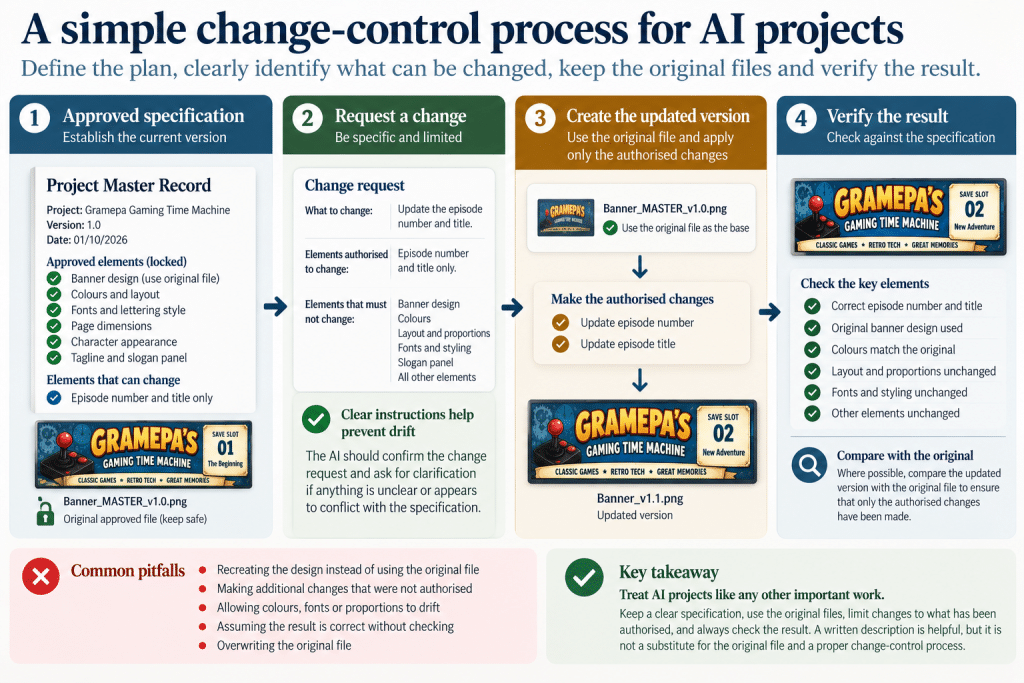
1. Establish a single source of truth
Every important project should have one authoritative document containing the current approved decisions.
This might be called:
- Project Master Record.
- Project Specification.
- Design Rules.
- Continuity Bible.
- Brand Guidelines.
It should clearly identify which version is current.
Old versions should be marked as superseded rather than left alongside the current version without explanation.
Where a project spans several conversations, the current master record should be made available whenever work resumes.
2. Lock approved decisions
Some decisions should be treated as permanent unless the user explicitly authorises a change.
For example:
APPROVED AND LOCKED
- Logo artwork.
- Brand colours.
- Page dimensions.
- Character appearance.
- Document structure.
- Required terminology.
A request to change one part of a project should not automatically permit changes to anything else.
However, it is important to understand that telling an AI something is locked does not create a technical guarantee that it cannot be changed.
The lock is a working instruction. It still needs to be supported by controlled files, clear change permissions and verification.
3. Preserve original files
If a logo, banner, photograph or approved design already exists, keep the original file.
Do not rely on a written description as the only record of what it looks like.
Use the original asset whenever possible.
For particularly important files, maintain a master copy and consider recording a checksum. A checksum is a digital fingerprint that can help establish whether a file has changed.
For example, a SHA-256 checksum can be used to compare files and detect whether their contents differ.
Keep original files separate from working copies so that an unsuccessful revision cannot destroy the approved master.
4. Introduce change control
Before making changes to an approved project, identify exactly what is being changed.
For example:
- Change requested: Update the episode title.
- Elements authorised to change: Title text only.
- Elements that must remain unchanged: Banner, masthead, colours, layout and proportions.
This prevents a small revision from becoming an unintended redesign.
If a requested change appears to conflict with an earlier decision, the AI should ask for clarification rather than silently choosing which instruction to follow.
5. Keep a version history
Use clear version numbers and dates.
For example:
- Version 1.0 – Original approved design.
- Version 1.1 – Approved title change.
- Version 1.2 – Approved wording correction.
Keep previous approved versions so that you can recover them if necessary.
A simple change log should explain what changed, when it changed and who authorised the change.
This is particularly useful when several people are working on the same project.
6. Check the result against the specification
Do not assume that a convincing-looking result is a correct result.
Check important details against the approved source.
For an image, this might include:
- Dimensions.
- Colours.
- Text.
- Layout.
- Proportions.
- Character appearance.
- Reuse of the correct master asset.
For a document, check its headings, wording, figures, structure and required content.
For a website, check that the changes have not affected unrelated pages or functions.
Where possible, use direct comparison rather than relying on the AI to assess its own work.
7. Require honest verification
An AI should distinguish between what it has actually done and what it merely believes it has done.
There is a significant difference between:
“I have used the original master file and checked the finished image against it.”
and:
“I have recreated the image based on the instructions.”
The first describes a specific action that can be checked. The second does not establish that the original has been preserved.
If the AI cannot access the original file, it should say so.
If it has not compared the result against the approved specification, it should not claim that verification has taken place.
Users should also remember that an AI’s own confirmation is not necessarily independent verification. For important work, the result should be checked using the original file, a suitable comparison tool or a human reviewer.
Download the AI Project Master Record Template
Keeping a reliable record of your project decisions, instructions and approved files is one of the simplest ways to reduce AI drift.
To help you put this into practice, FRUKit has created a free AI Project Master Record Template. It provides a central place to record your project brief, important instructions, approved decisions, original files, authorised changes and version history.
You can complete it in Word, save a separate copy for each project and update it as the work develops.
The principle is simple: don’t rely on an AI conversation to be the only place where important project information exists. Keep your own authoritative record.
Download the AI Project Master Record Template (Word)
8. A practical Project Integrity Protocol
For anyone using AI for ongoing work, the following simple protocol provides a useful starting point.
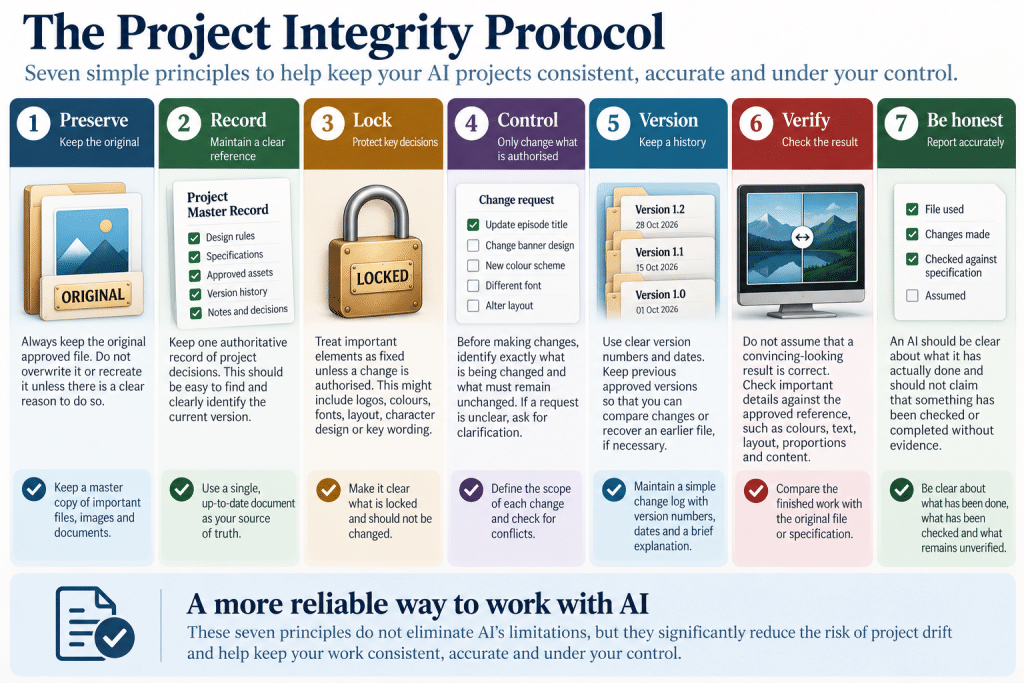
| Principle | What it means |
|---|---|
| Preserve | Never overwrite or recreate an approved original unnecessarily |
| Record | Keep one authoritative record of project decisions |
| Lock | Treat approved elements as fixed unless a change is authorised |
| Control | Only change what has been authorised |
| Version | Keep identifiable previous versions |
| Verify | Check finished work against the approved reference |
| Be honest | Never claim something has been checked or completed without evidence |
This approach does not eliminate the limitations of AI. It reduces the opportunities for those limitations to damage the project.
It also has an important side benefit: it makes the project easier for another person, or another AI assistant, to understand and continue.
The protocol is not complicated. It is essentially good project management applied to work involving AI.
9. What does this mean for small businesses?
AI is becoming accessible to people who have no technical background and cannot afford specialist staff.
That is one of its greatest advantages.
A small business owner can use AI to draft correspondence, prepare marketing material, improve website content, analyse information and develop ideas.
However, businesses should be careful about treating a conversational AI as an independent record-keeping or project-control system.
For important work:
- Keep business records outside the conversation.
- Store approved documents and assets in an organised location.
- Check figures, dates and customer-facing information.
- Do not assume that an AI remembers every previous decision.
- Do not let an AI silently change established business rules.
- Review important outputs before publishing, sending or relying on them.
A useful additional practice is to identify the level of importance attached to each task.
A draft social media post may require a relatively simple check. A change to a company’s logo, a customer quotation or a financial document deserves considerably more attention.
For high-risk activities involving finance, legal obligations, personal information or customer commitments, human review remains essential.
AI can assist with the work, but responsibility for the final decision should remain with an appropriately informed person.
The aim is not to discourage small businesses from using AI. It is to help them use it sensibly, without assuming that a conversational assistant is a substitute for proper business records and procedures.
10. The future: Better tools and better working practices
The research into instruction drift suggests that improving AI reliability is not simply a matter of making models larger or giving them more information.
Systems also need to become better at maintaining a consistent working state over time.
Potential improvements include:
- More reliable project memory.
- Structured records of approved decisions.
- Better distinction between permanent rules and temporary requests.
- Automatic checks against approved specifications.
- Better handling of corrections and version history.
- Clearer reporting of what has actually been completed.
- More reliable reuse of original files and assets.
- Better ways of identifying conflicts between old and new instructions.
Some of these improvements can be introduced through the way people organise their work today. Others require advances in AI systems themselves.
The research into State Integrity Collapse also suggests that structured ways of maintaining important constraints may improve reliability under certain conditions. This is encouraging, although it does not mean that a simple project document will eliminate every form of drift.
The responsibility should not fall entirely on users. AI developers need to continue improving the reliability of systems that are increasingly being used for serious work.
An assistant that can produce impressive results but cannot reliably preserve important decisions is still an incomplete tool for long-running projects.
Conclusion: A good answer is not enough
AI can produce impressive results. It can help people do things that would previously have required specialist knowledge, considerable time or additional staff.
But there is a difference between producing an impressive answer and being a dependable long-term assistant.
A dependable assistant must understand not only what is being requested now, but also what has already been agreed, what must not change and which previous decisions remain authoritative.
Our experience with the Gramepa Gaming Time Machine demonstrates how easily a seemingly small failure to preserve an approved asset can gradually affect an entire piece of work.
The research shows that this is part of a wider reliability challenge being investigated by the AI research community.
For anyone using AI in business, the message is simple:
Do not confuse an AI’s ability to remember an instruction with its ability to follow that instruction consistently.
Keep your own records. Protect your original files. Lock important decisions. Control changes. Check the results.
And remember that an AI saying something is correct does not make it correct.
The real measure of an AI assistant isn’t how brilliantly it completes a new task. It’s whether it can reliably preserve the work that has already been completed.
Further reading and research
The following academic sources provide further information for readers who wish to explore the subject.
- Kenneth Li, Tianle Liu, Naomi Bashkansky, David Bau, Fernanda Viégas, Hanspeter Pfister and Martin Wattenberg (2024), Measuring and Controlling Instruction (In)Stability in Language Model Dialogs.
https://arxiv.org/abs/2402.10962 - Philippe Laban, Hiroaki Hayashi, Yingbo Zhou and Jennifer Neville (2025; published at ICLR 2026), LLMs Get Lost In Multi-Turn Conversation.
https://proceedings.iclr.cc/paper_files/paper/2026/hash/59f6421e64707225fdf5b28840679a07-Abstract-Conference.html - Xiaodong Wu, Minhao Wang, Yichen Liu, Xiaoming Shi, He Yan, Lu Xiangju, Junmin Zhu and Wei Zhang (2025), LIFBench: Evaluating the Instruction Following Performance and Stability of Large Language Models in Long-Context Scenarios.
https://aclanthology.org/2025.acl-long.803/ - Yancheng Zhu and Yifan Yuan (2026), When LLMs Forget What They Believe: Characterizing State Integrity Collapse in Long-Horizon Dialogues. In Proceedings of the 2026 Conference on Empirical Methods in Natural Language Processing, pages 13334–13350.
https://aclanthology.org/2026.emnlp-main.583/
This article is intended as an accessible introduction, not a technical diagnosis of any particular AI product. Research findings describe the models and test conditions examined by the authors; they should not automatically be assumed to apply equally to every AI system.