
When Online Attention Comes With a Price
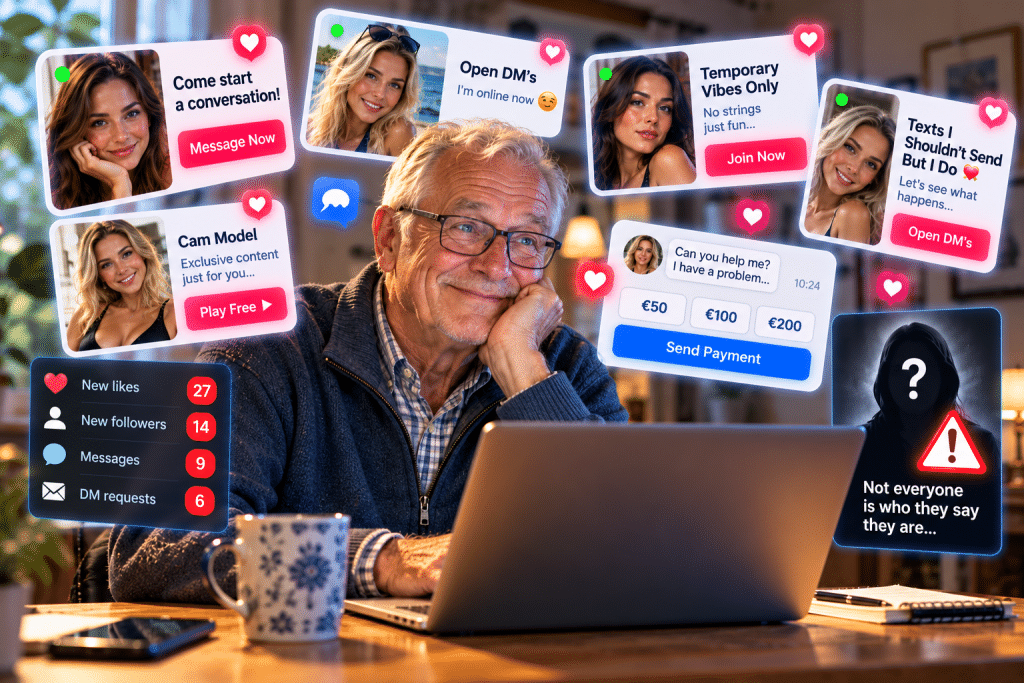
“Come start a conversation!”
“Open DMs.”
“Temporary vibes only.”
“Cam Model.”
“Play Free.”
“Texts I shouldn’t Send But I Do.”
“Pin-Up Model.”
If you spend any amount of time on social media, you’ve probably encountered profiles like these.
They may appear in your feed, follow you unexpectedly, send you a message, like your posts or encourage you to move the conversation somewhere more private.
Sometimes they’re exactly what they appear to be.
Sometimes they’re genuine people selling adult content or companionship online.
And sometimes the attractive person suddenly interested in you isn’t really interested in you at all.
That’s where things get interesting — and potentially expensive.
Let’s get one thing straight
There is nothing inherently wrong with adults choosing to sell companionship, entertainment or sexual content online.
That’s not what this article is about.
The problem begins when someone deliberately creates a false relationship with another person in order to obtain money, personal information, photographs, account access or other benefits.
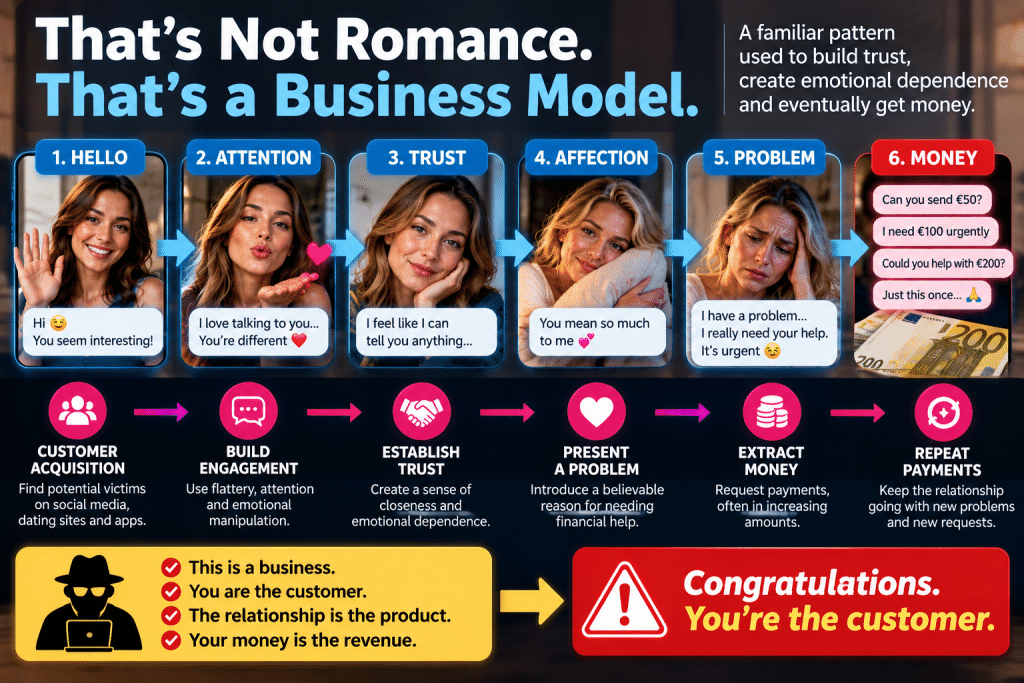
That’s not romance.
That’s not companionship.
That’s a business model built around manipulating another human being.
And unfortunately, the internet has made that business model remarkably easy to operate.
“But we’ve been talking for months…”
This is where things become particularly difficult.
A common assumption is that somebody being scammed would realise almost immediately.
They don’t.
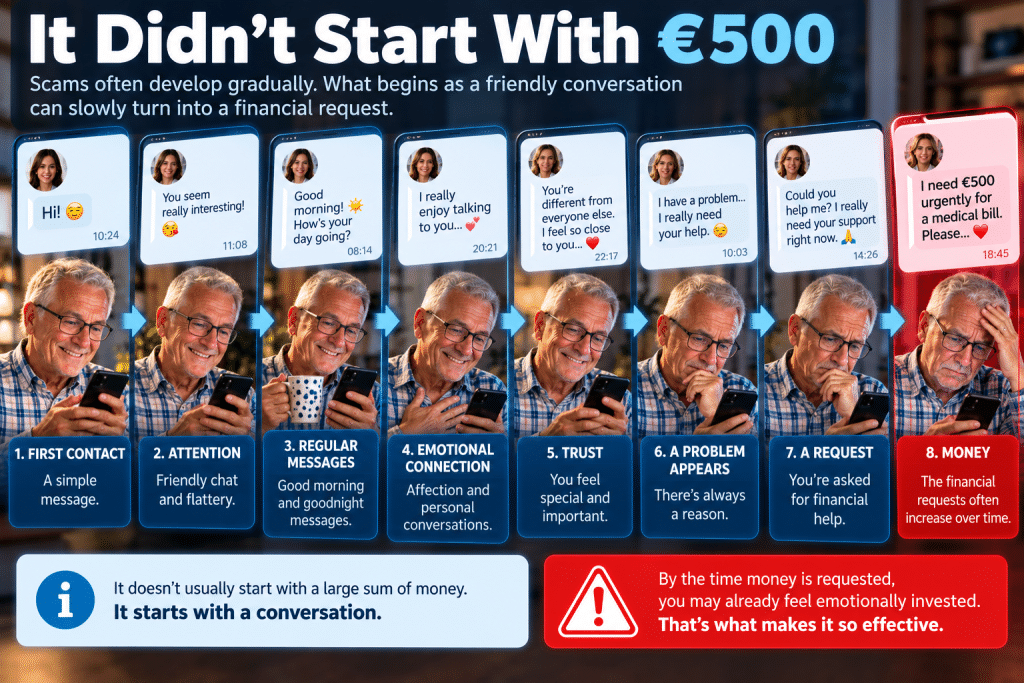
A sophisticated scam doesn’t necessarily begin with:
“Hello. Please send me €500.”
It might begin with:
“Hi.”
Then:
“You seem interesting.”
Then a few conversations.
Then regular messages.
Then good morning and goodnight messages.
Then personal stories.
Then affection.
Then perhaps photographs.
Eventually there is a problem.
A medical emergency.
A broken phone.
A trip that needs paying for.
A problem with a bank account.
A visa.
A family emergency.
A promise to visit.
Or perhaps simply:
“If you really cared about me…”
And suddenly the relationship has a price attached to it.
The warning signs aren’t always obvious
One of the biggest problems with online scams is that individual warning signs can look completely harmless.
Someone following you isn’t suspicious.
Someone being attractive isn’t suspicious.
Someone wanting to chat isn’t suspicious.
Someone selling content isn’t necessarily suspicious.
Even asking for money isn’t automatically proof that somebody is a scammer.
It’s the pattern that matters.
Be particularly cautious when an online relationship involves several of these:
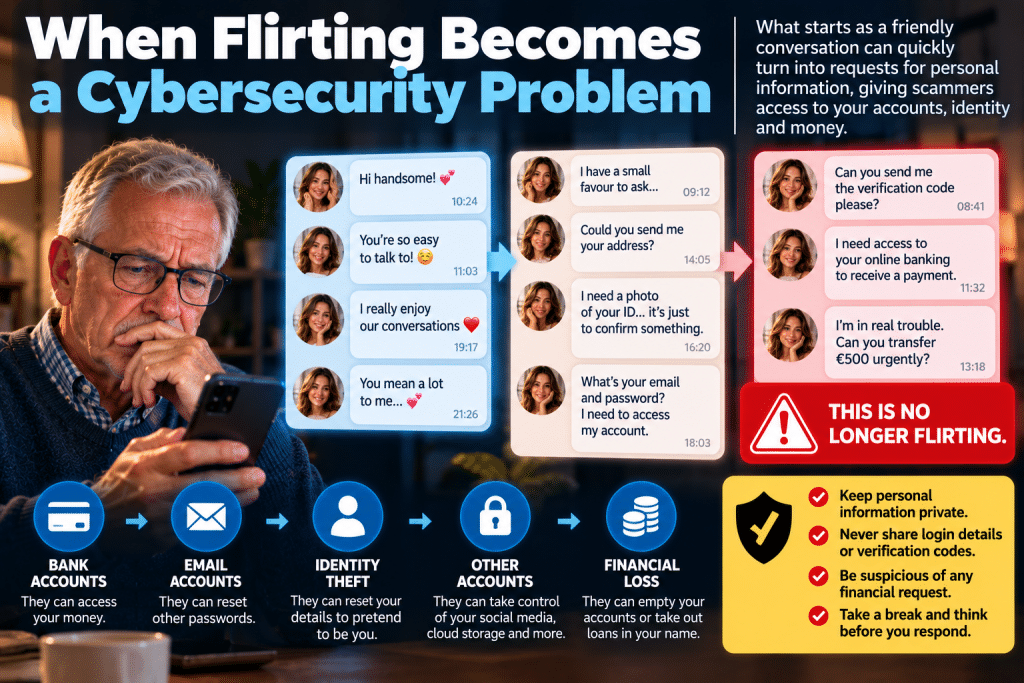
They quickly become emotionally attached
You’re suddenly their favourite person.
They call you pet names.
They tell you that you’re different from everyone else.
They claim they’ve never felt this way before.
And you’ve known them for three days.
That’s a bit quick, Dave.
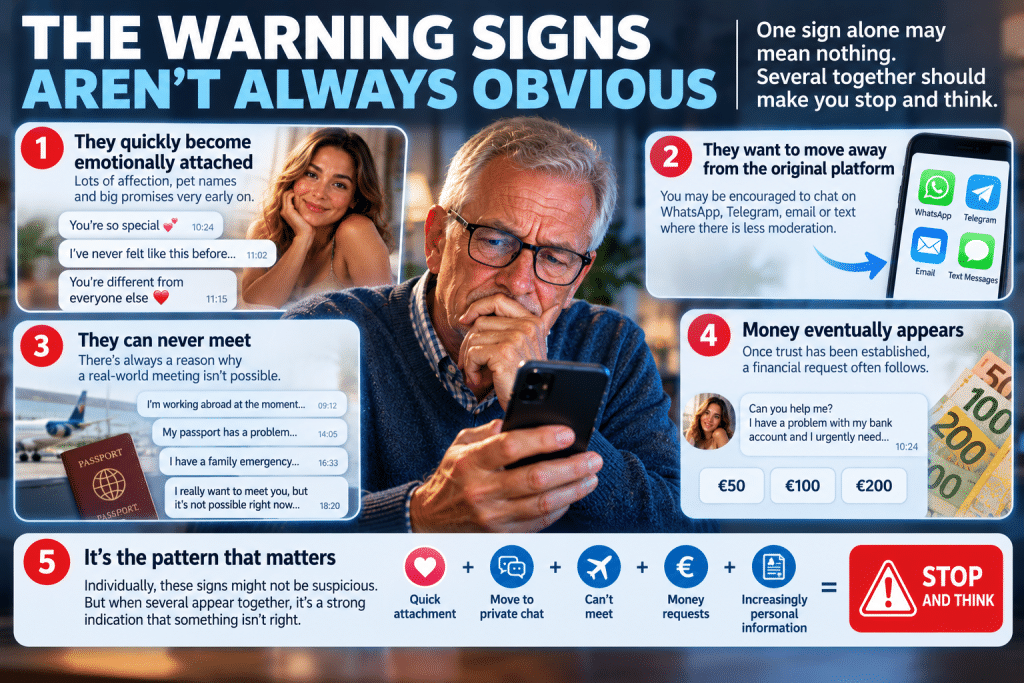
They want to move away from the original platform
You might be encouraged to move to WhatsApp, Telegram, email, text messages or another private service.
There can be perfectly legitimate reasons for this.
But moving the conversation away from a platform can also make reporting and moderation more difficult.
Their circumstances always prevent meeting
There’s always a reason.
Work.
Travel.
Family.
Money.
A passport.
An emergency.
The classic:
“I really want to meet you, but…”
If the relationship has existed for months and there is always another reason why a real-world meeting cannot happen, step back and look at the situation objectively.
Money eventually appears
This is the big one.
Once money enters a relationship that exists almost entirely online, stop and think.
Don’t let embarrassment prevent you from questioning it.
Don’t assume that because you’ve already sent money, you need to send more.
And don’t send money simply because refusing makes you feel guilty.
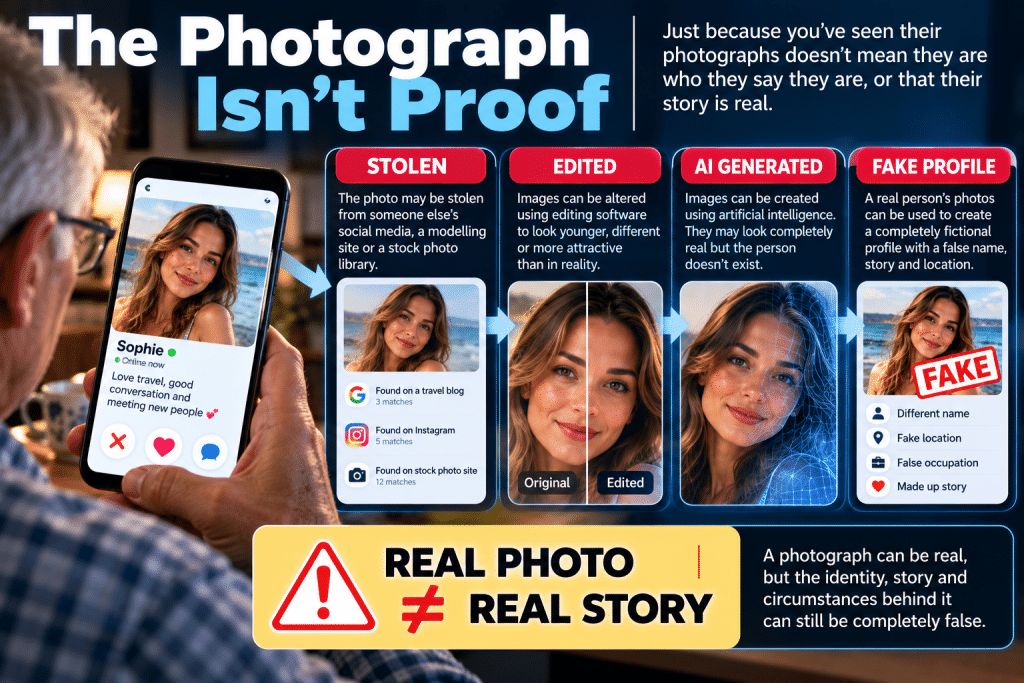
The photographs aren’t proof
This catches people out.
You might think:
“But I’ve seen her photographs.”
That doesn’t prove anything.
Images can be stolen.
Images can be edited.
Images can be generated.
Videos can be manipulated.
Profiles can be entirely fictional.
Even a video call isn’t an absolute guarantee that everything you’ve been told is true.
The person on the other end may be real.
The story may not be.
And then there is the really nasty stuff
Some scams don’t stop at money.
Once someone has established trust, they may start asking for:
- intimate photographs
- copies of identification
- addresses
- telephone numbers
- email addresses
- banking information
- passwords
- verification codes
- photographs of payment cards
- access to social-media accounts
- access to computers or phones
This is where an apparently harmless online flirtation can turn into a cybersecurity problem.
And once someone has compromising photographs or personal information, the situation can become even more unpleasant.
That’s when blackmail and sextortion can enter the picture.
Older people are not stupid
This point is important.
Scammers don’t succeed because their victims are stupid.
They succeed because humans are human.
Loneliness, companionship, affection, curiosity and the desire to feel wanted are powerful things.
And scammers understand that.
Someone can be highly intelligent, experienced in business and perfectly capable of running a household — and still be vulnerable to somebody who spends several hours every day making them feel special.
Digital literacy isn’t about being clever.
It’s about knowing what can happen online before it happens to you.
A very simple FRUKit rule
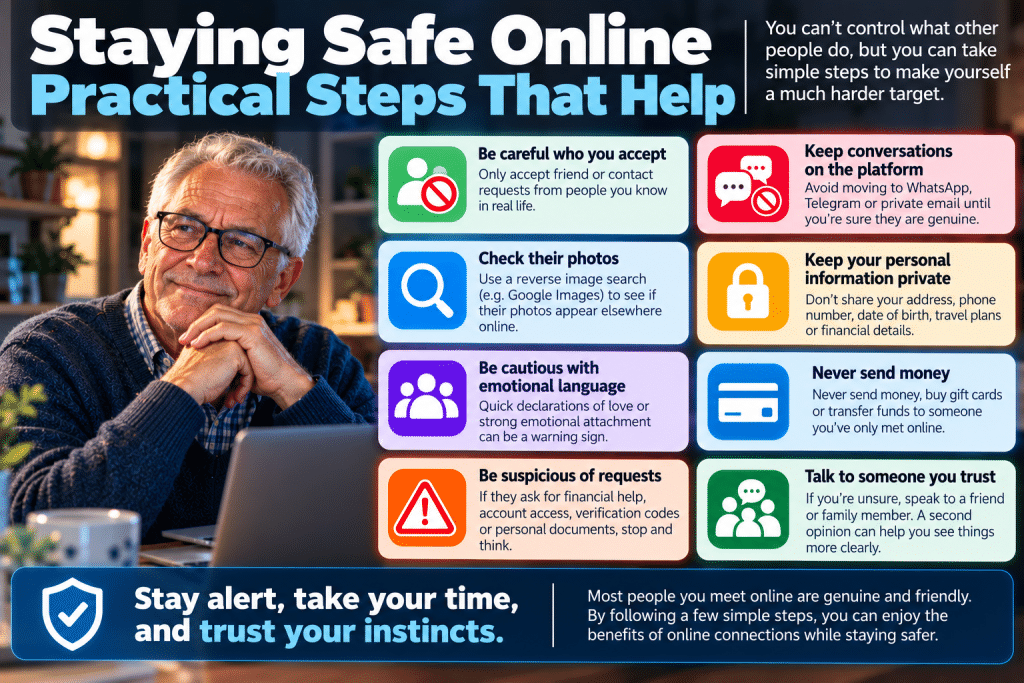
If someone you’ve never met online suddenly becomes extremely interested in you, enjoy the attention — but don’t suspend your common sense.
Ask yourself:
What do they actually know about me?
What do I actually know about them?
What have I independently verified?
And what happens if I stop sending money?
That last question can be particularly revealing.
If affection disappears the moment the money stops, you’ve learned something important about the relationship.
Never be embarrassed to ask for help
This is perhaps the most important advice of all.
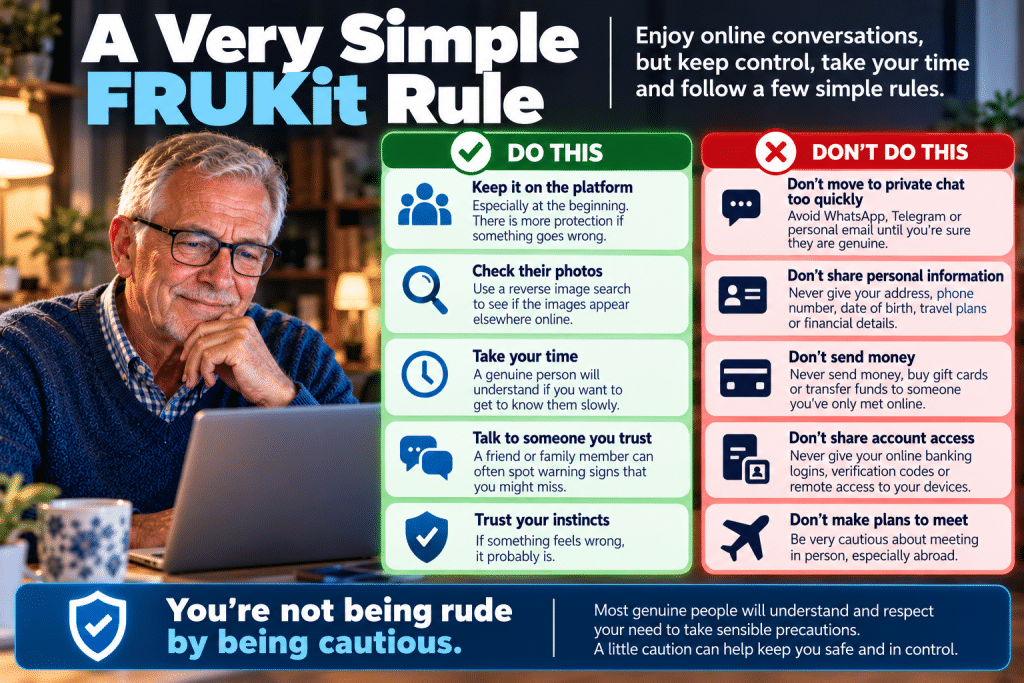
If you think you’ve been caught up in something like this, don’t hide it because you’re embarrassed.
Talk to somebody you trust.
Don’t send any more money while you work out what’s happening.
Don’t delete evidence.
Keep messages, usernames, photographs, payment records and transaction details.
Change passwords if you’ve shared them.
Enable two-factor authentication.
And if you’ve given somebody access to your computer, phone or accounts, treat it as a security incident, not simply a relationship problem.
The sooner you involve somebody else, the easier it can be to stop the situation getting worse.
And finally…
There is absolutely nothing wrong with enjoying a bit of attention online.
Let’s face it, we could all do with a little ego boost occasionally.
But when a complete stranger appears from nowhere, tells you that you’re incredibly attractive, wants to move into your DMs, falls madly in love with you and then discovers an urgent need for €500…
that’s probably not destiny knocking.
It’s probably somebody’s business model.
And remember:
If the relationship requires your bank account before it requires your surname, something has gone horribly wrong.
FRUKit — helping English-speaking people in France use technology with a little more confidence.